Read the full report: South East Devon Visitor Survey 2020-21
The most common activity was dog walking
with roughly 3 in every 5 interviewees stating that this was their main activity (285 interviewees, 57%). However, these were the self-reported single choice main activities, and it should be noted that while 57% of interviewees gave their main activity as ‘dog walking’, in fact 65% of interviewees had a dog with them. Those interviewees who had a dog with them included those who stated that their main activity was walking (38 interviewees, 25% of those walking), bird/wildlife watching (3, 23%), running/jogging (2, 15%), canoeing/kayaking (1, 50%), “other” (1, 17%) and cycling (1, 6%). The percentage of interviewees who had at least one dog with them was 73% on the Pebblebeds, 48% on the Exe and 90% at Dawlish Countryside Park.
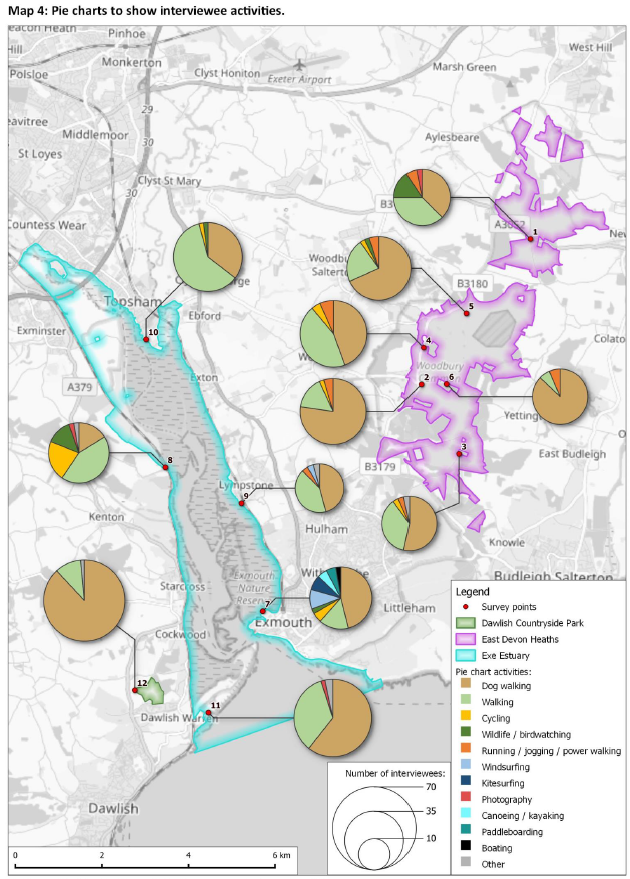
The next most common response was walking, (150 interviewees, 30%). 64 interviewees (13%) gave an activity type that was not dog walking or walking and these included a range of activities such as cycling, running, wildlife watching, watersports etc. Activity types are summarised by site in Figure 6 and by survey point in Map 4.

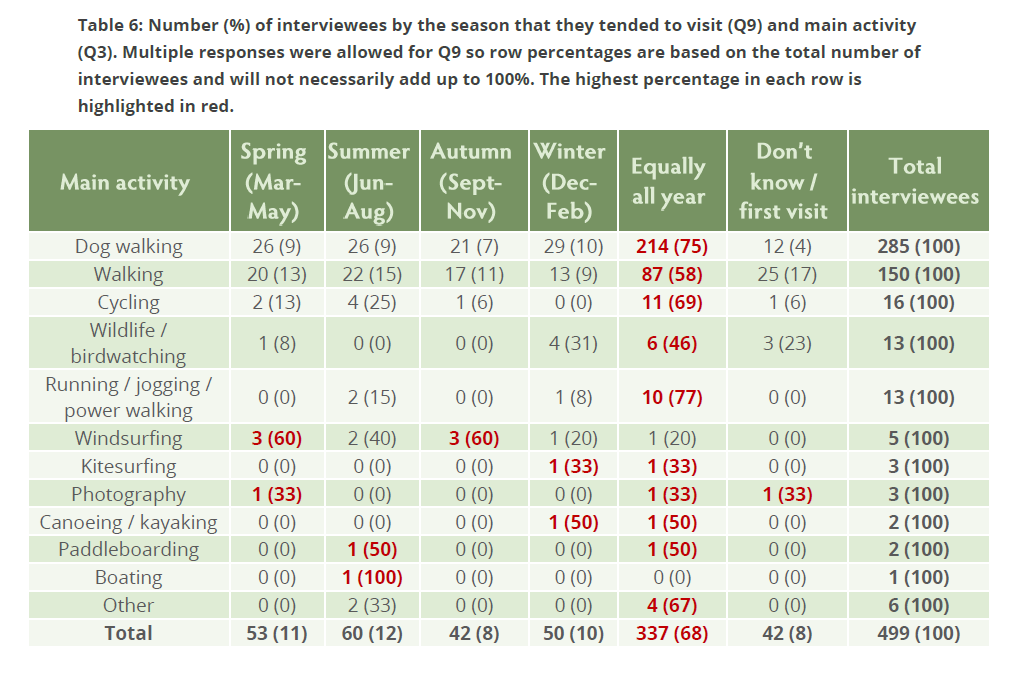
Around two thirds of interviewees (337 interviewees, 68%) indicated that they tended to visit equally all year round.
However, this varied by activity type, for example 31% of interviewees who were wildlife/birdwatching said that they tended to visit more in the winter (Table 6).
Over a third of interviewees (173 interviewees, 35%) indicated that the time of day that they visited varied, and they did not have a regular time that they visited. Of those who did give a time period, the most common response was ‘before 9am’, given by a quarter (25%) of interviewees.
Examination of the routes (taken by visitors) showed that 75 interviewees (36% of interviewees on the Exe) took routes that passed through intertidal areas within the Exe Estuary SPA.
In response to Q11, which asked interviewees at the Exe Estuary whether they went onto the intertidal areas at all, only 14 interviewees (7%) said they had, and an additional 3 interviewees (1%) said only their dogs had. However, examining the routes in GIS showed that 75 interviewees (36% of interviewees on the Exe) took routes that passed through intertidal areas within the Exe Estuary SPA. 35 of these interviewees were at Dawlish Warren, 22 at Exmouth Duck Pond, 17 at Lympstone and 1 at Goat Walk.
Out of 499 interviewees, 491 of them were able to describe the route that they had taken during their visit, or the route that they planned to take.
Across all sites, the length of interviewees’ routes ranged from 170m to 32.73km, with a median length of 2.27km (Table 7). The median route lengths on the Pebblebeds and the Exe were similar, 2.46km and 2.59km respectively. At Dawlish Countryside Park the median route length was 1.68km. The longest routes at Dawlish Countryside Park were made by interviewees who had done two laps of the park. Interviewees at Powderham tended to have the longest routes, with a median length of 5.29km. Routes at other survey locations were mostly shorter than 5km.
Overall, the most common reason given by interviewees for choosing to visit the particular location where interviewed was that it was close to home.
However, the reasons for site choice did vary by site (Figure 14), and at Dawlish Countryside Park the most common reason was because they could let their dog off the lead (37% of interviewees). On the Exe Estuary, the scenery was also a particularly important factor, given by 32% of interviewees.
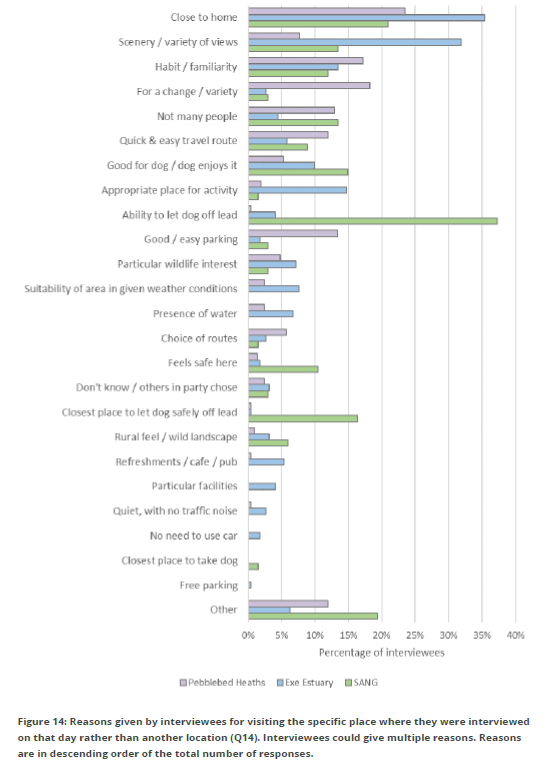
Reasons grouped under ‘Other’ included visiting on a recommendation from a friend (6 interviewees), seeing a route in a magazine/book (3 interviewees) and specifically wanting to visit Woodbury Castle Hillfort (3 interviewees).
For those interviewed at Dawlish Countryside Park, 31% would have visited the Exe Estuary instead and a further 16% another coastal location away from the Exe.
Almost all interviewees (465, 93%) were able to name an alternative site that they would have visited for their activity if they could not visit the location where they were interviewed. Only 4% said that they wouldn’t have visited anywhere and 3% were unsure or didn’t answer this question.
30% of those interviewed on the Exe gave another place on the estuary as the alternative they would visit, and a further 16% indicated they would have visited the coast. 7% of those interviewed on the Exe would have gone to the Pebblebeds instead and the most commonly cited single location outside the Exe Estuary was Dawlish Countryside Park (cited by 8% of those interviewed at the Exe Estuary sites).
For those interviewed on the Pebblebeds, 63% gave an alternative location within the Pebblebed Heaths. 10% gave a location on the Exe Estuary and a further 4% gave other coastal locations away from the Exe. The most common single destination given away from the Heaths was Exmouth (8%).
For those interviewed at Dawlish Countryside Park, 31% would have visited the Exe Estuary instead and a further 16% another coastal location away from the Exe. The most commonly cited single alternative was Dawlish Warren (19% of interviewees there) and then Dawlish (15%).
In Figure 15 we show the most frequently cited alternative locations and the shading reflects the different interview locations. The percentage values reflect the percentage of interviewees that named the alternative location.
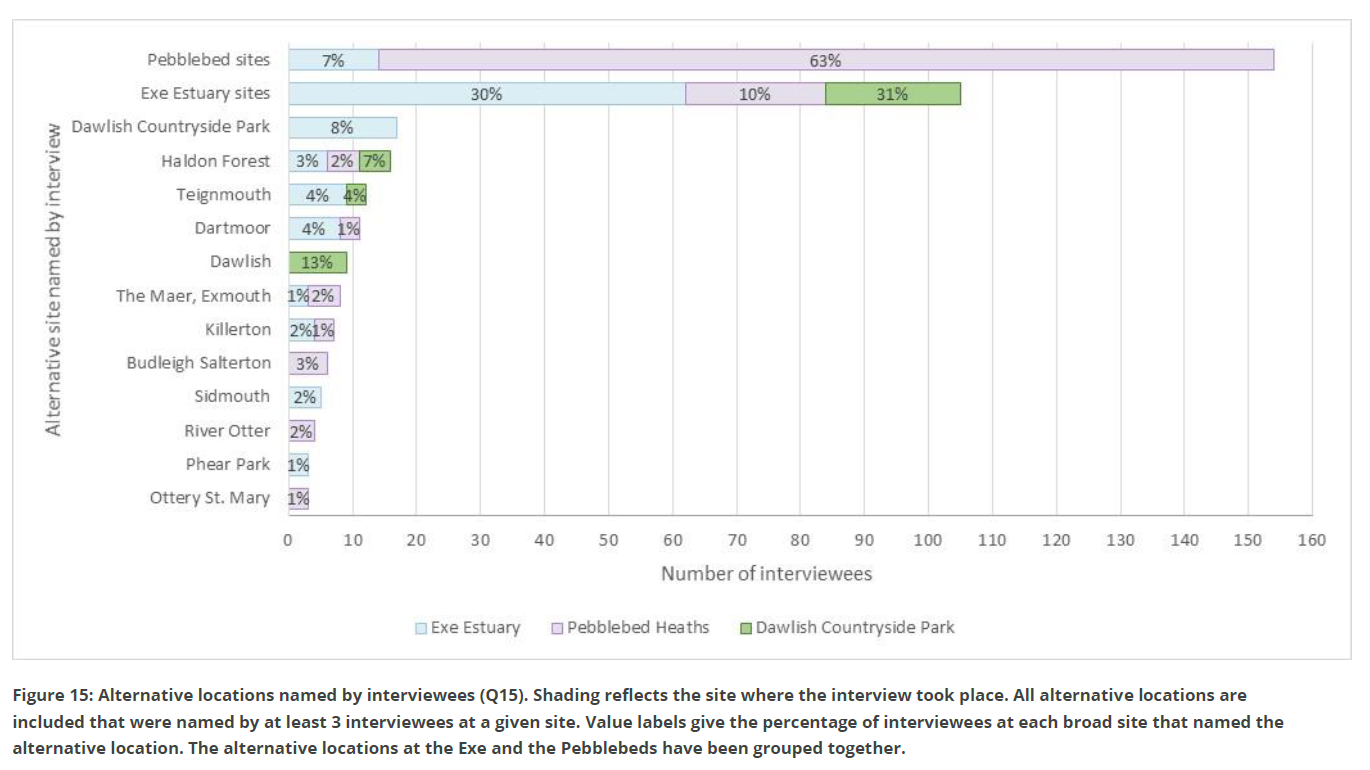
Dawlish Countryside Park was named by 17 interviewees on the Exe Estuary in Q15 as an alternative site that they would visit instead of their interview location. In addition to this, when directly asked (Q16) another 75 interviewees said that they had visited Dawlish Countryside Park. However, most of these were infrequent visitors, with 85% (64 interviewees) visiting the SANG less than once a month. In total, therefore, 44% of interviewees on the Exe Estuary had visited Dawlish Countryside Park.
Overall, 30% of dog walkers (86 interviewees) had heard of Devon Loves Dogs.
Interviewees who were dog walking were asked if they had heard of, or were members of “Devon Loves Dogs”. Overall, 30% of dog walkers (86 interviewees) had heard of the organisation. A higher percentage of dog walkers had heard of the organisation at the Pebblebeds (36% of dog walkers, 50 interviewees), compared to the Exe (30% of dog walkers, 27), and Dawlish Warren Country Park (15% of dog walkers, 9).
In total, 5% of all dog walkers interviewed were members of “Devon Loves Dogs”, and this percentage was 4% of dog walkers (3 interviewees) on the Exe Estuary, 6% (8) on the Pebblebeds and 3% (2) at Dawlish Countryside Park.
Previous surveys were undertaken in 2010 (Exe Estuary) and 2015 (Pebblebed Heaths) and used broadly similar methods. The data suggest a number of changes. Most striking is the change in the number of visitors, with marked increases suggested at all sites.
Comparisons provide some opportunities to check how access has changed.
In order to ensure as like-for-like a comparison as possible we have filtered the data from each survey to give the closest match in terms of survey effort, survey locations and timing (so for example we have excluded the data from the Turf survey point on the Exe which was surveyed in 2010 but not in 2020/21. There are of course important caveats to note in that the surveys are ‘snapshots’ in time and represent just 2 days at each location in the most recent survey which also coincided with the Covid pandemic.
In Table 11 we provide a summary of selected metrics, drawing on the relevant data from the different surveys. We have included Dawlish Countryside Park in the table simply to allow a comparison across the different sites.
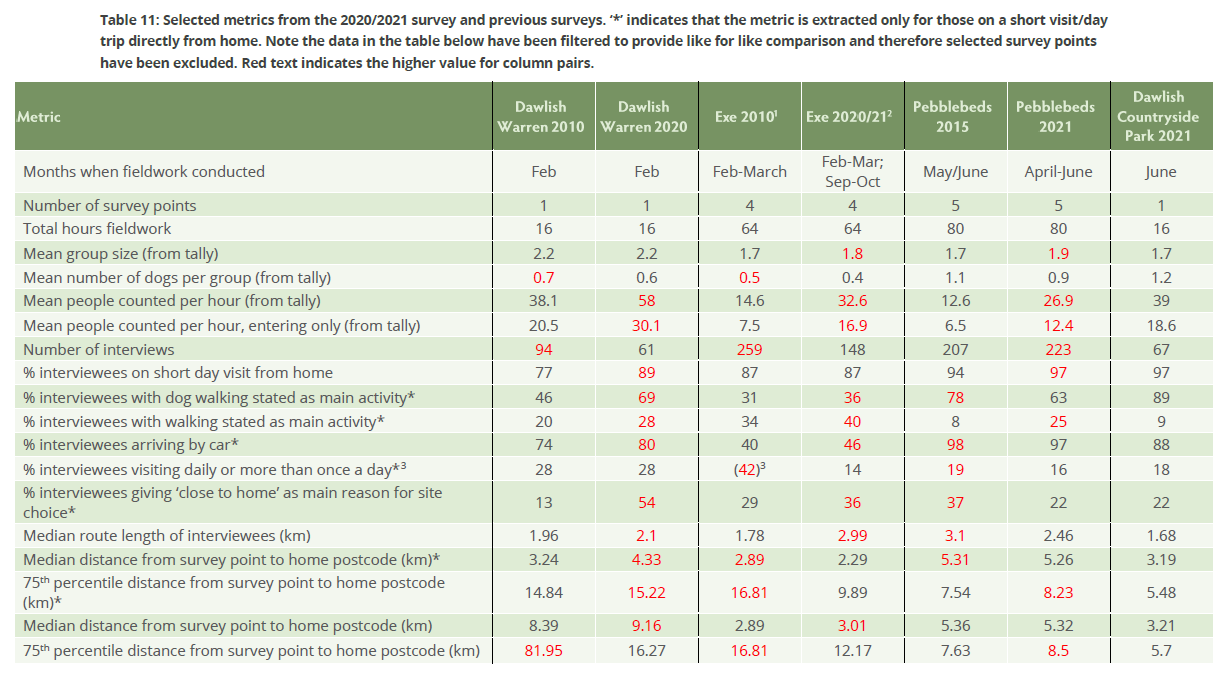
The data show overall totals of footfall per hour are more than double on the Exe Estuary (excluding Dawlish Warren) and on the Pebblebed Heaths compared to the previous survey. The change at the Pebblebed Heaths from 12.6 people entering per hour in 2015 to 26.9 people per hour in 2021 represents a 213% increase over 6 years.
The mean number of dogs per group appears to have dropped slightly at all sites, suggesting perhaps that there have been bigger increases in the use from those visiting without dogs. The percentage of interviewees who gave dog walking as their main activity decreased on the Pebblebeds (78% to 63%) but increased at the other sites. The percentage of people who stated walking was their main activity appears to have increased at all sites, particularly the Pebblebeds (8% of interviewees to 25%).
There were no clear differences in the postcode data between the different surveys, suggesting that people who visit the relevant sites are not living any further afield or closer now compared to the previous survey.
Mann-Whitney tests comparing the median values for the distance from home postcode to survey point for Dawlish Warren (2010 and 2020), Pebblebeds (2015 and 2021) and Exe Estuary (2010 and 2020), using the comparable data from the same survey points, were not significant (significance >0.05 in all cases).
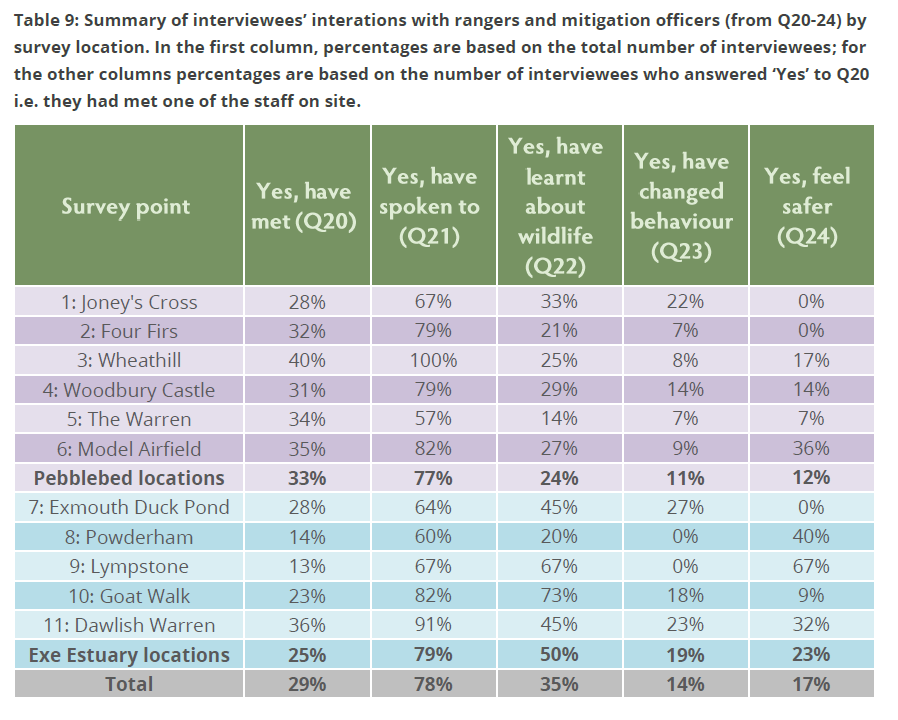
A third of interviewees (33%) at the Pebblebeds and a quarter of interviewees (25%) on the Exe Estuary had met one of the rangers or mitigation officers.
Of those who had met a ranger or mitigation officer, 78% had spoken to them. Interactions with rangers and mitigation officers are summarised in Table 9.