
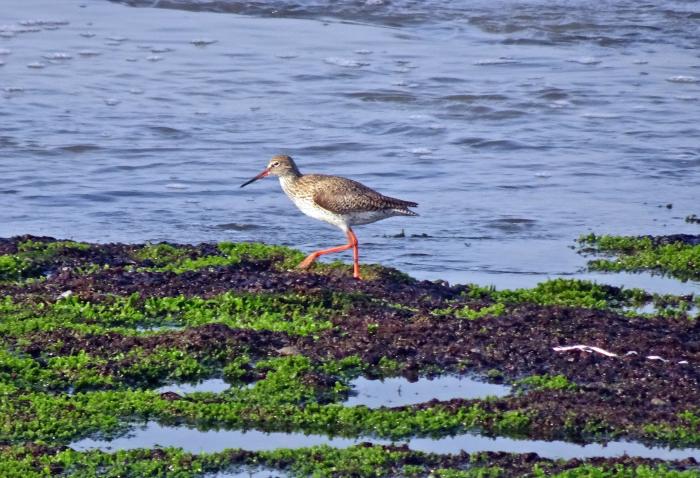
If you’ve ever walked along the Exe Estuary and heard a loud, sharp whistle echoing across the mudflats, chances are it was a Common Redshank (Tringa totanus) sounding the alarm. With their bright orange-red legs and clear, piping calls, these lively waders are hard to miss. They’re often the first to raise the alarm when danger’s near, earning them the well-deserved nickname “Warden of the Marshes.”
Redshanks have a speckled brown back and wings, a pale belly, and a straight bill that’s orange at the base and black at the tip. When they take flight, you can spot a bright white wedge on their back and tail — a real giveaway for anyone watching from the shore.
Each winter, the Exe Estuary becomes a vital refuge for Redshanks, offering plenty of feeding grounds and safe roosting spots. Counts from the BTO’s Wetland Bird Survey (WeBS) show that while numbers naturally rise and fall from year to year, the overall population has remained fairly stable. The highest count was recorded in 1978 with 1,186 individuals, compared to 657 in 2017 — a gentle decline, but still a strong wintering presence on the estuary.
While Redshanks do well on the Exe in winter, it’s a different story for their breeding populations across the UK. They’re now an Amber-listed species under Birds of Conservation Concern (2021), meaning their breeding numbers are in decline. Britain is particularly important for them, holding over 18% of north-western Europe’s Redshank population (up to 172,000 breeding pairs).
When it comes to nesting, Redshanks are particular about their surroundings. They have preference for open grasslands, mires and saltmarshes, where they can find a mix of short, damp grass for feeding and taller clumps (called tussocks) to hide their nests in. Each pair usually raises one brood a year, laying around four eggs, with both parents sharing incubation duties for about 24 days. The chicks hatch covered in soft down and with their eyes open, ready to walk and feed almost straight away. This independence helps them survive in such an open habitat — but it also makes them vulnerable to predators, which is why those grassy hiding spots are so important.
Recent research found that between 1985 and 2011, the number of Redshanks breeding on British saltmarshes fell from over 21,000 pairs to fewer than 12,000 — a 44% drop. The steepest declines were seen in the northwest of England, where heavy grazing by livestock remains common, even on some conservation sites. Although grazing can be beneficial in small doses, too much of it shortens the vegetation, removing the tussocks Redshanks need for nesting and leaving their eggs and chicks exposed to predators.
The good news is that we know how to help. Studies suggest that light, well-timed grazing created ideal Redshank habitat — keeping the right balance of open feeding areas and clumped nesting cover. The key is timing. By keeping livestock out of nesting areas between mid-April and mid-July (the Redshanks’ breeding season) we can protect their nests and give chicks a better chance to survive. Approaches like rotational grazing or delaying the start of grazing each year have proven especially effective.
Getting this balance right doesn’t just help Redshanks — it benefits a whole range of saltmarsh wildlife. These “wardens of the marshes” have long been a symbol of our estuarine landscapes, and with thoughtful management, we can make sure their bright calls continue to ring out across the Exe for many years to come.
Redshank are classified in the UK as Amber under the Birds of Conservation Concern 5: the Red List for Birds (2021).