
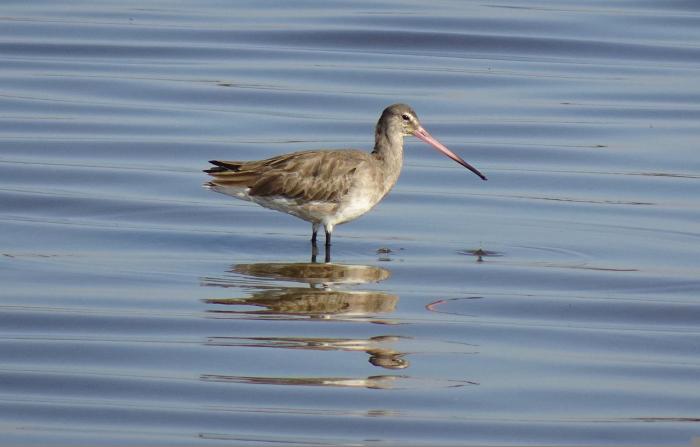
As autumn days shorten and winter creeps in, the Exe estuary becomes a haven for thousands of overwintering birds. Among the most elegant and fascinating are Black-tailed Godwit (Limosa limosa) and Bar-tailed Godwit (Limosa lapponica). These long-legged waders travel thousands of miles to escape the harsh Arctic and northern European winters, gracing the mudflats of the Exe from September through March.
Despite appearing superficially similar (elegantly long legged with long straight bills), Black-tailed and Bar-tailed Godwits have key differences — in appearance, behaviour and migration routes.
Black-tailed Godwit
Most common godwit on the Exe in winter.
Black and Bar-tailed Godwits have similar over wintering populations within the UK (around 41,000 and 53,000 respectively), but you’re much more likely to see a Black-tailed Godwit on the Exe. This may be a reflection on available habitat, Black-wits having a slight preference for feeding in shallow water and soft estuarine mud of the upper estuary, close to the undisturbed haven of RSPB Bowling Green Marsh.
Shows a bold black tail and an obvious white wing bar in flight.
While the black tail may be evident in the name, standing side-by-side, it can still be tricky to tell these birds apart. In flight, it’s much easier: Black-tailed Godwits have an obvious white wing bar and Bar-tails don’t. I remember it as: bar-no bar.
Long, straight bill with orange at the base.
The bill is longer in the female, so the different sexes don’t compete for food.
Tall, elegant build with long legs.
So elegant, but critically longer than its similarly named counterpart. In flight, the feet protrude behind the bird. When standing, the difference is most evident in the upper section – the tibea – look between the ‘knee’ and ‘tummy’.
The UK mainly hosts Black-tailed Godwit from Icelandic breeding grounds, which migrate here for the winter.
Bar-tailed Godwit
Less numerous on the Exe, but present in smaller flocks or as individuals.
Tail is barred, not solid black — giving it its name. It’s so subtle, so you do have to get your eye in on this one.
Slightly upturned bill. And I mean, slight.
Shorter legs
This is really evident in flight, where the feet are not visible trailing behind the bird – as they are with Black-wit.
Prefers slightly more coastal areas, often seen on sandier areas such as at Dawlish Warren NNR and occasionally Exmouth Wildlife Refuge.
British wintering birds breed in northern Scandinavia and Siberia, following the Baltic coast along East-Atlantic flyway.
Migration Routes: Two Paths, Two Stories
While both species are long-distance migrants, the routes they take to reach the UK differ significantly, affecting their population dynamics and conservation pressures.
Black-tailed Godwit (Icelandic population)
Breeds in Iceland.
Migrates directly to Britain and Ireland, with many wintering along estuaries like the Exe, Thames, and Wash.
Some continue to Spain or Portugal, but the UK is a major stronghold.
The route is relatively short, direct, and well-studied.
Because of this, the Icelandic Black-tailed Godwit population is stable, though still classified as Near Threatened due to limited breeding range and wetland pressures.
Bar-tailed Godwit (European population)
Breeds in the high Arctic tundra of Scandinavia and western Siberia.
Migrates along the East Atlantic Flyway, stopping at key sites such as the Wadden Sea (Netherlands, Germany, Denmark) before reaching the UK, Ireland, and west Africa.
This longer and more complex route depends heavily on international stop-over sites — especially the Wadden Sea, a vital feeding ground.
Bar-tailed Godwits wintering in the UK belong to the lapponica subspecies, which is currently doing reasonably well — but its worth knowing that other global populations (like the Pacific baueri subspecies) are facing steep declines due to habitat loss along their routes.
The reliance on multiple staging sites makes Bar-tailed Godwits more vulnerable to changes along the flyway, especially coastal development and sea-level rise.
Winter Behaviour: Feeding and Flocking
In winter, godwits prioritise rest and respite. This time is essential to re-gain body weight lost by the effort of migration and breeding.
Feeding: Using their long bills to probe the mud, they seek out worms, molluscs, and crustaceans. Their sensitive bills can detect prey even in total darkness — making dusk and dawn prime feeding times. Look out for them along the shore and adjust your route to avoid disturbing them.
Roosting: At high tide, godwits gather in large roosts. See them locally at RSPB Bowling Green Marsh or Dawlish Warren Wildlife Refuge. These gatherings can be spectacular to witness, but please remember to give birds space and observe from a respectful distance.
Social Dynamics: Black-tailed Godwits are often more gregarious, forming tightly packed feeding flocks, while Bar-tailed Godwits may spread out more thinly. To keep you on your toes, they also intermix.
Conservation - How You Can Help
On the Exe, rising sea levels, human disturbance, and pollution are ongoing concerns. Simple actions like keeping dogs on leads, avoiding roosting birds at high tide, and supporting habitat management make a big difference.
Visit responsibly – observe birds from a distance, especially during cold snaps when energy conservation is crucial.
Respect the Wildlife Refuges – remain out of the Wildlife Refuges to avoid disturbing wintering birds while they rest or feed.
Support wetland conservation – whether through volunteering, donating, or spreading awareness, every action helps protect these migratory marvels.
Interested in getting involved in bird counts? Monitoring the population of wintering birds guides the management of our nature reserves. The BTO runs training sessions on how to become a Wetland Bird Survey volunteer: details here
Black-tailed and Bar-tailed Godwits are more than just seasonal visitors — they are global travellers relying on the health of the Exe Estuary for their survival. As you walk along the shoreline this winter, spare a moment to watch them — delicately stepping through the mud, resilient and graceful against the tide. They are a reminder of how connected our local landscapes are to faraway shores, and how vital it is to keep these places safe for generations of birds (and people) to come.
Black-tailed Godwit are classified in the UK as Red under the Birds of Conservation Concern 5: the Red List for Birds (2021). Priority Species under the UK Post-2010 Biodiversity Framework. Listed as Near Threatened on the global IUCN Red List of Threatened Species.