

Winter 2025
Spectacular sunsets and thousands of wading birds: Winter with the Wildlife Wardens
Welcome to the latest edition of Shores, Heaths and Dunes, the newsletter of South East Devon Wildlife! As we race towards the excitement of Christmas and the New Year, navigating through rainstorms, clear blue skies, and frosty mornings, we’d like to share an update on what the Wildlife Wardens have been up to over the past few months.
Exmouth Wildlife Refuge – A Big Thank You!
As always, we’ve spent a lot of time at the Exmouth Wildlife Refuge, which remains active from September 15th to December 31st. You may have spotted our trusty blue gazebo near the Imperial Recreation Ground. As Warden Sama mentions in her article, we’ve noticed significantly less human disturbance at the refuge this year, which has allowed birds like Brent geese, wigeon, and black-tailed godwits to rest and feed in peace, building the strength they need before their long migrations back to northern Europe and Siberia. A huge thank you to everyone in Exmouth and visitors alike for your continued support!
Wildlife Refuge Competition
We’ve also been running a monthly competition with a prize draw for two tickets on the Stuart line bird cruise and a bird ID guide. This has been a fantastic success, with over 1,200 entrants and a lot of effort from Wardens Claire and Sama in promoting it on social media.
New Partnership
You may have noticed that we’ve partnered with Exmouth Port Authority to lease their boat, Harbour Patrol on a trial basis, replacing our own boat, Branta Isca. While Branta Isca has served us well, it wasn’t ideal for the stronger winter winds, limiting our patrols in those conditions. This new partnership means you’ll likely see us more frequently over the winter months, zipping around the estuary to monitor the refuges and keep an eye on what’s happening on the Exe. We'll make a decision about whether to extend use of the Port Authority's RIB later next year.
Other Sites
In addition to our work at Exmouth, we’ve continued our patrols at the Pebblebed Heaths and Dawlish Warren, dodging the occasional rain shower while witnessing the beauty of autumn turning to winter and discovering a range of fascinating fungi. Warden Imo, who has been on maternity leave, has joined us for some "Keeping in Touch" days, teaching us about the various fungi we've encountered along the way.
Volunteers
We’re also fortunate to have the support of both new and returning volunteers, whose help has been invaluable. Their knowledge and enthusiasm are always a welcome addition to our team, so a huge thank you to all our volunteers!
Winter Walks & Birdwatching
The remainder of the newsletter includes suggestions for winter walks and tips on species to look out for, whether you're out on a family walk over Christmas or just looking to beat the winter blues in January and February. We’ve also included updates from Ryan, the new Countryside Ranger at Dawlish Warren, and from the RSPB at Aylesbeare Common, along with insights into the birds we’ve spotted on the estuary this year.
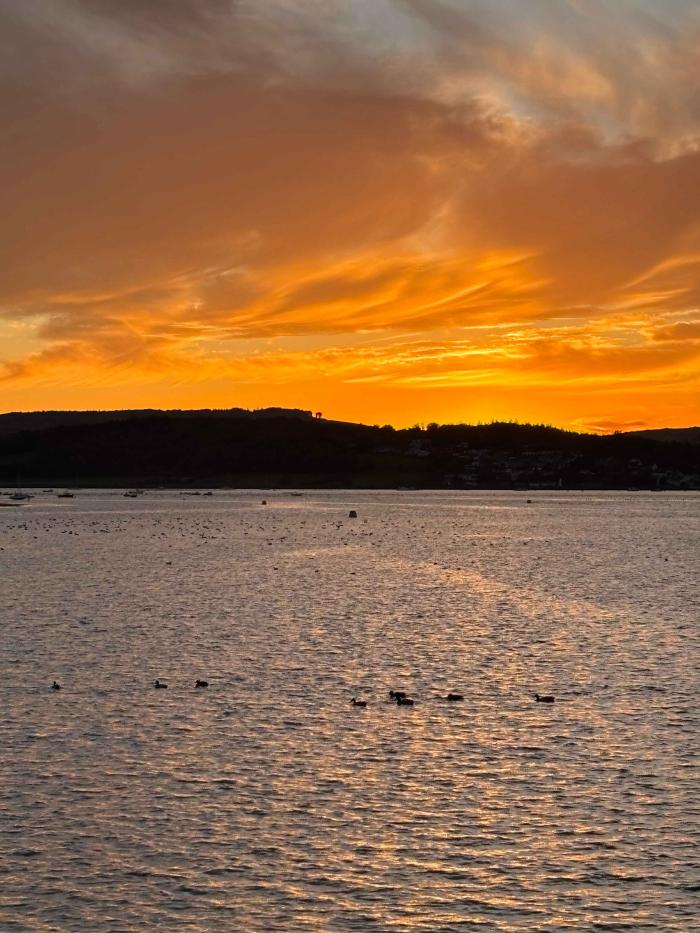
Sunset over the Exmouth Wildlife Refuge
What to look out for this winter...
Starlings
A natural winter phenomenon when thousands of Starlings flock together and create amazing shapes in the skies before settling down to roost in reedbeds, conifer plantations and some large structures such as piers. The flocking together is called a ‘mumuration’ and is thought to be due to the sound all those tiny wings make as they fly together, which sounds almost like a murmur. December and January tend to bring the largest flocks but murmurations can be seen any time between October and March. They generally occur just before sunset and just after sunrise. Look out for local murmurations on the Exe Estuary, at Budleigh Salterton and near to Topsham, together with well known locations such as RSPB’s Ham Wall and WWT Steart Marshes, near Bridgwater.
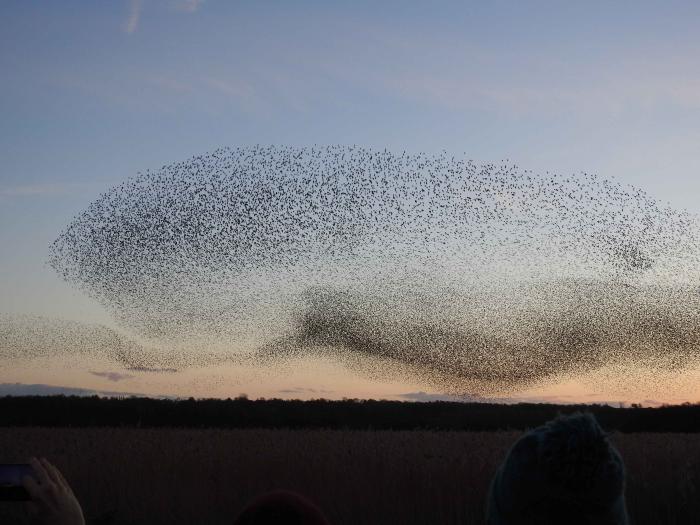
Starling murmuration
Look out for flocks of small songbirds at Warren Point (Dawlish Warren), there is a good chance they are Linnets. Linnets in winter are a small brown finch with a thick, short beak, flashes of white on their wings and forked tails. They often erupt into the air with a crescendo of melodious twittering. In spring, male linnets transform from ‘little, brown jobs’ to a fancy pinky red chest, silvery grey head and chestnut coloured head. Linnets take their name for their love of linseed, the seed of the flax plant.
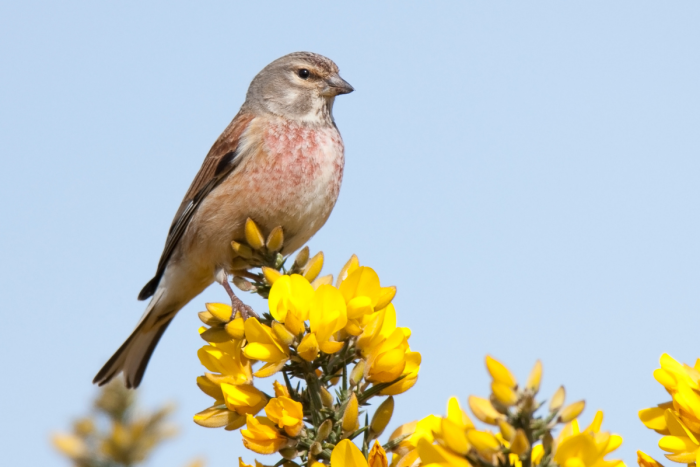
A Linnet on gorse (courtesy Thames Basin Heaths Partnership)
A handsome duck we see in small numbers at Lympstone and Exmouth Wildlife Refuge. The pintail has an unmistakable forked tail, a small head and curved back pointed wings. A small number breed in the UK, however most pintail fly over here in the winter from northern Europe swelling the numbers present to approximately 20,000. Pintail are dabbling ducks which means that they feed at the surface rather than diving down and eat sea grass in the winter, and molluscs and insects when they’re breeding. Most pintail live for approximately 3 years, however the oldest ever recorded was 27!
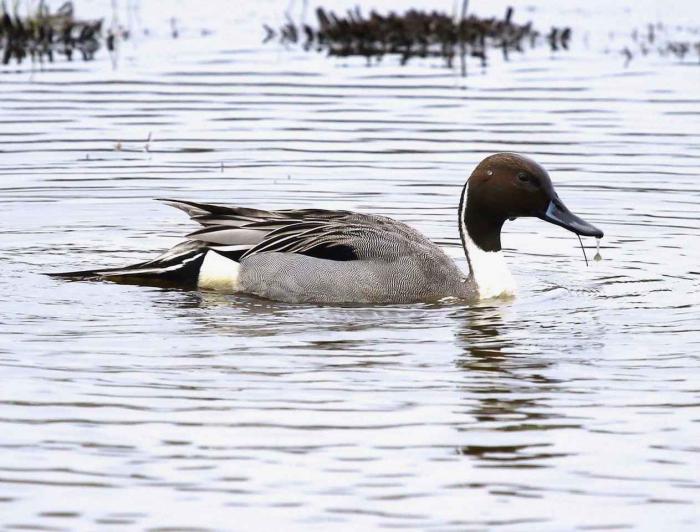
Pintail duck (photo: Derek Carter)
As the days get shorter and the nights turn frosty, there’s not many flowers that we can expect to see in the local area over winter. The exception to this is European gorse, with its bright yellow pea like flowers, which with a low winter sun really look like they’re glowing amongst the green and brown of the scrub on the Pebblebed Heaths. It's not just a plant to lift our spirits in winter, it's also an important roost for birds that stay here all year round such as the Dartford warbler. When a lot of other trees and shrubs are losing their leaves, gorse stays reliably green and dense, making it a great, albeit spiky, place for birds to cosy up when it’s cold.
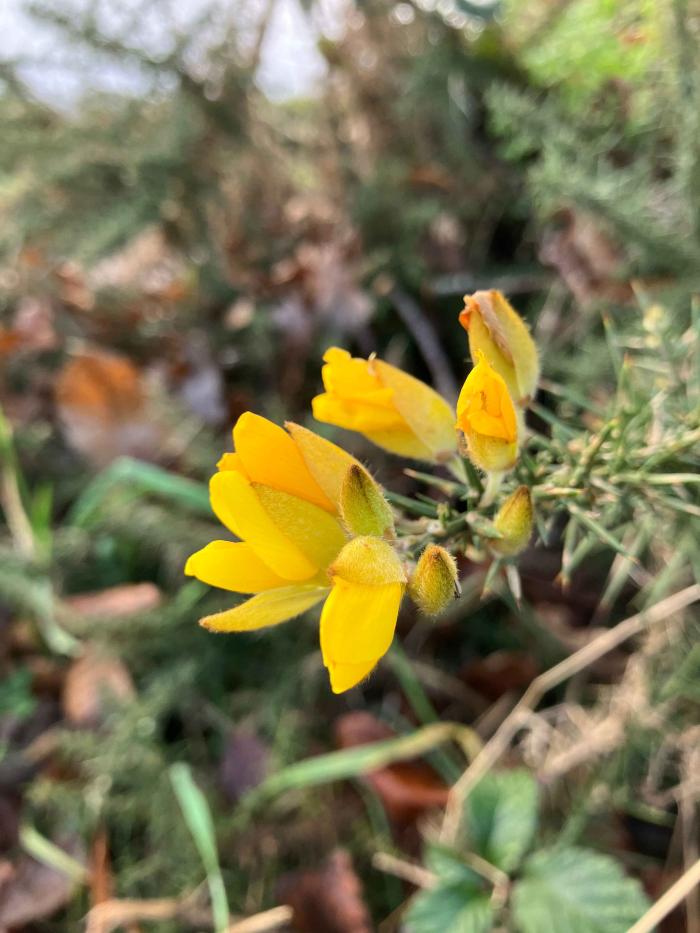
European gorse in flower
As 2025 draws to a close (no we can’t really believe it either), we wanted to take a moment to reflect on the season so far and share some highlights from the estuary. Flicking back through the diary, we're reminded of how much we’ve accomplished and how many wonderful wildlife conversations we’ve had with visitors to our local nature reserves recently. If you were one of those visitors, thank you for stopping by the Wildlife Gazebo — we always enjoy connecting with others who share our passion for nature.
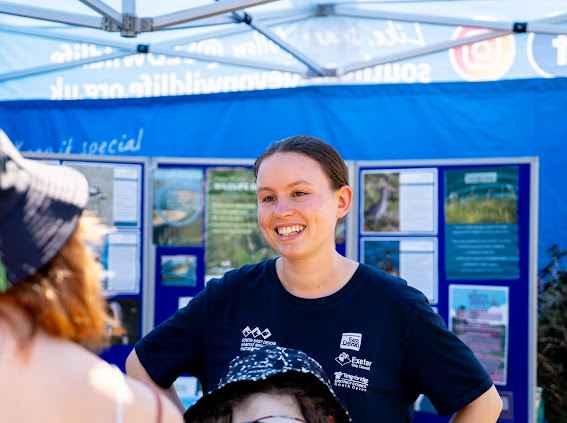
Warden Claire at the Wildlife gazebo
One of the most encouraging things to report on this year, has been the significant reduction in dogs entering Exmouth Wildlife Refuge and putting the birds to flight. Since September 15th, when the refuge went active, we’ve recorded only five incidents of dog disturbance - a real improvement from years past. Continued disturbance to resting and feeding shore birds, causes them to burn the precious energy they need to recover from migration, and ultimately affects how fit a bird is to breed again the following year. Given the ongoing pressures from avian influenza, habitat loss along migration routes, and climate change affecting breeding grounds, it’s more important than ever that we protect these vital wintering areas. So, if you’ve kept your dog away from the Duck Pond or avoided the Refuge while paddle boarding, kayaking, or kitesurfing, thank you! Small changes like these make a big difference to wildlife.
If you do see disturbance at Exmouth or Dawlish Warren Wildlife Refuge, please report it here. We’re not always on site, and knowing where disturbances happen helps us target our efforts more effectively.
With the colder weather now upon us, the warmer days of September seem a distant memory - but the arrival of Autumn is always an exciting time for the team and that keeps our spirts high (if not the mercury)! As the holiday crowds thin out, we eagerly watch for the return of our overwintering birds to the Exe. This year, when Exmouth Wildlife Refuge became active on September 15th, we were thrilled to see both Light-bellied and Dark-bellied Brent geese bobbing about in it. Quite a number, and with juveniles!
Although they look similar, these two subspecies join us from very different shores. Light-bellied Brent geese breed in Greenland, with migration stop-offs in Ireland, here in the southwest UK, and then on finally to France. Dark-bellied Brent geese, on the other hand, breed in the Siberian Arctic, migrating along the Baltic coast to winter on the south coast of the UK. We typically see a peak in Light-bellied Brents on the Exe in September as they pass through en-route to France, and again in March/April when they head back to their breeding grounds. For the rest of the winter, however, the Brent geese you’ll see here are almost certainly Dark-bellied fellows.
Autumn migration on the Exe begins as early as late July, with waders like Curlew and Oystercatcher arriving after long migrations from their breeding grounds. Through October and November, bird numbers continue to build in the Wildlife Refuge with 800+ Brents and 1000+ Wigeon recorded in Exmouth Wildlife Refuge this year. It’s always a sight to behold, the Wigeon males, with their striking amber heads, are particularly stunning in the low winter sun. For the best views, visit Exmouth Duck Pond up to Mudbank along the Weasel Run an hour or two after high tide.
Numbers of these two key species are slightly lower in Exmouth Wildlife Refuge this year than we have recorded in previous years. Ever hopeful, I’d like to think they are feeding in other locations around the estuary, rather than this statistic suggesting population decline. With shifting sands on the lower estuary in recent years, we frequently see Brents in high numbers on the sandbar in the middle of the river. Analysis of our data in combination with Wetland Bird Survey (WeBs) counts from across the estuary will reveal a clearer picture.
On the positive side, we’ve seen a greater numbers of Black-tailed Godwits in the Refuge this year. These elegant, long-legged waders breed in Iceland and migrate directly to the UK. Their sensitive bills allow them to find food even in the dark, which is useful as daylight hours shorten. We’ve also seen the return of the single Grey Plover from last year! Grey Plover are charming birds and a regular winter visitor to the Exe. Their soft coloured, subtle plumage is pale beneath and cloud grey above. At high tide, they often gather in numbers with other waders such as Oystercatcher and Dunlin at safe roosting sites like 'hide island' and 'finger point' within Dawlish Warren Wildlife Refuge. Why so solitary at Exmouth Refuge? We’d love to know.
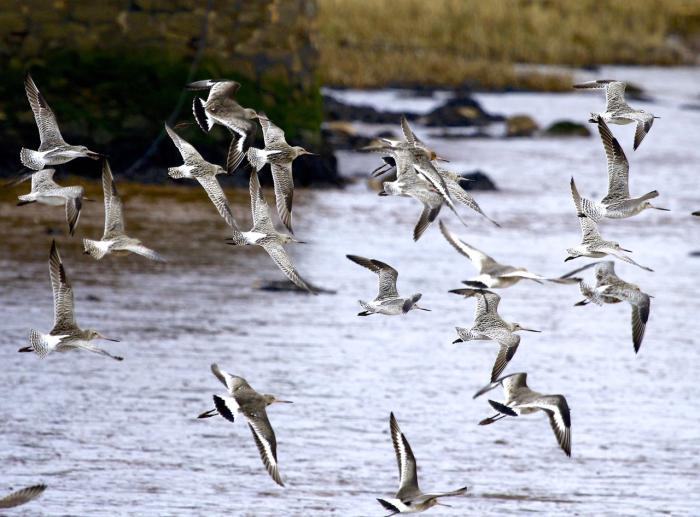
Black and bar tailed godwits. (photo: Derek Carter)
It’s great to be able to introduce these characterful birds to all those passing. If you’ve stopped by at the Wildlife Gazebo this season, or at one of our free Guided Birdwatching events – it’s been so nice to meet you. Do remember to check our social media for free events, they are a great way to connect with the natural heritage that surrounds us.
Finally, to December. This month usually marks the peak of bird numbers across the estuary, and we’ve been lucky to see a wonderful variety of species visible from the shore. There have been good numbers of Dunlin, Redshank, Curlew, Oystercatcher, Turnstone, Egret, and a frequent Kingfisher commuting to Mudbank. Lots of sightings of Great-crested Grebe this year too! While the Exmouth Wildlife Refuge comes to an end on December 31st, wintering birds will stay with us until March. After the new year, look for Dark-bellied Brents in large flocks feeding in fields between the Clyst and Darts Farm. This is often the best time to spot juveniles, who are typically the last to arrive.
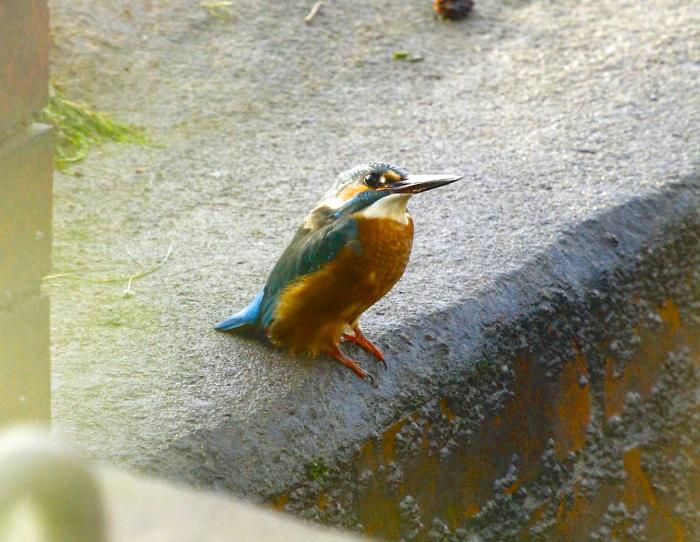
Kingfisher. (photo: Derek Carter)
We’re hoping for a stronger showing of juveniles this year after none were recorded last season. Ideally, we’d like to see juveniles making up around 15% of the flock to maintain a healthy population. Last year, we didn’t hit that target. There could be a variety of reasons — predation, migration stress, or changes to their breeding grounds. What we can do, though, is ensure that the Exe provides safe, undisturbed habitat to give them the best chance while they’re here.
Thanks so much for being part of this season’s journey on the estuary. We wish you all the best for the rest of the year and hope to see you again in 2026.
Happy winter wildlife watching!
Our team is expanding and we need your help!
As Christmas approaches and we look ahead to a brand-new year, we’re thrilled to share some exciting news: our ranger team is growing!
In 2026, we’ll be expanding from three to six Wildlife Wardens on the ground. Of course, we'll tell you more when we can - watch this space!
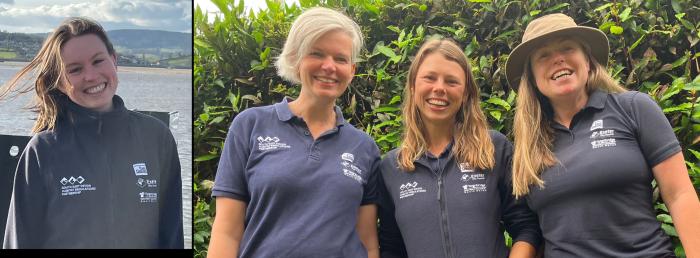
Our current team of Wildlife Wardens, (L-R) Claire, Katie, Imo and Sama.
With more boots on the estuary, heaths and dunes comes the need for more resources, including a brand-new warden van and gazebo. As we’re expanding, we’ll be sourcing a new hybrid van and gazebo and we want you to help design them!
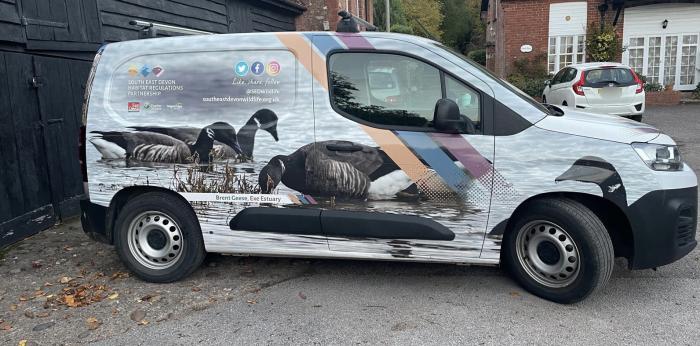
Many of you will recognise our current electric van, decorated with Dark Bellied Brent geese, as a familiar sight parked in our nature reserves. With a second van joining the fleet, it’s the perfect moment for a fresh look.
So, we’re inviting amateur photographers of all ages and abilities to send us their photos, with the winning images featuring on our new vehicle. By submitting images, you give your permission for them to be added to our photo bank to be used in our communications—such as newsletters, interpretation boards, and social media. Keep your eyes peeled as they may showup on your feed one day.
How to Enter
Visit our website page for full details on how to take part.
📅 Photo Call- Out closes: Monday 19th January 2026
For the van, we’ll be selecting three photographs, each representing one of the beautiful sites we protect: Dawlish Warren, the Pebblebed Heaths, and the Exe Estuary.
Dawlish Warren National Nature Reserve | South East Devon Wildlife
The Pebblebed Heaths | South East Devon Wildlife
Exe Estuary | South East Devon Wildlife
Whether you’re drawn to sweeping landscapes or tiny details, wildlife portraits or atmospheric sunsets—this is your chance to get creative and celebrate the places you love.
What We’re Looking For
Your photographs must:
- Contain large amount of blank space (such as sky, sand, water etc.) for text to be overlayed
- Be high enough resolution (150dpi minimum) to be enlarged without pixelation (if shortlisted, we may contact you for a higher-resolution file).
- Be taken at one of our three reserves (Exe Estuary, Dawlish Warren or Pebblebed Heaths)
- Be original images captured by you.
- Been taken without causing wildlife disturbance or harmful behaviour.
- Not involve drone use (drones are not permitted on these sites).
- Not be AI-generated.
By submitting images, you agree to the terms and conditions and you give your permission for us to use the photos in future publicity. You can submit up to three photographs.
Where to Walk This Christmas: Winter Wildlife on Your Doorstep
As the temperature drops and the festive season presses in, many of us feel the pull to get outdoors and stretch our legs. Summer may be for beach days and sun-soaked afternoons, but winter brings its own kind of magic—crisp mornings, big skies, and that cosy return home to a warm cup of tea.
If you’re looking for beautiful winter walks where you can shake off the cold and enjoy our incredible local wildlife, here are some wonderful places to explore this Christmas.
Otter Estuary Walk
If you haven’t visited the newly restored lower River Otter yet, winter is the perfect time. This remarkable landscape is now bustling with overwintering migratory birds discovering this abundant estuary — and it’s a wonderful place to experience wildlife when enjoyed with care.
Regular visitors include redshank, curlew, oystercatchers, mallards and shelduck — and even an osprey that stayed for several weeks in autumn. Over 120 species have been recorded here, including several of conservation interest such as whimbrel and black-tailed godwit, so please take a moment to watch from paths and viewpoints to avoid disturbing these special birds.
The estuary lies within the East Devon Area of Outstanding Natural Beauty, and a network of easy, accessible footpaths makes exploring simple and enjoyable.
Walk at a Glance
- Length: 3.2 miles
- Dogs: On-lead (to protect wildlife)
- Accessibility:4/5 – Mostly gravel paths
- Difficulty: Easy
- Parking: Available at Lime Kiln Carpark or Otter Estuary Car Park
- Length: 2.4 miles
- Dogs: Off-lead (Secure dog training area available)
- Accessibility:4/5 – Wheelchair accessible
- Difficulty: Easy
- Parking: Free parking at the train station
This walk is rich with wildlife. You’re almost guaranteed to spot signs of beavers or otters—and if you’re lucky, you may see one in person. Please keep dogs on leads at all times to avoid disturbance.
The estuary is a Site of Special Scientific Interest (SSSI) and part of a Marine Conservation Zone, so while you explore, please follow local wildlife guidelines: stick to footpaths, give birds plenty of space, keep noise low, and always pick up dog waste. Drones, fires, BBQs and wild camping are not permitted.
Tip:
You can extend this walk by following the estuary to the coast path and looping back to Otterton.
For more information on the route: Otterton Loop | South East Devon Wildlife
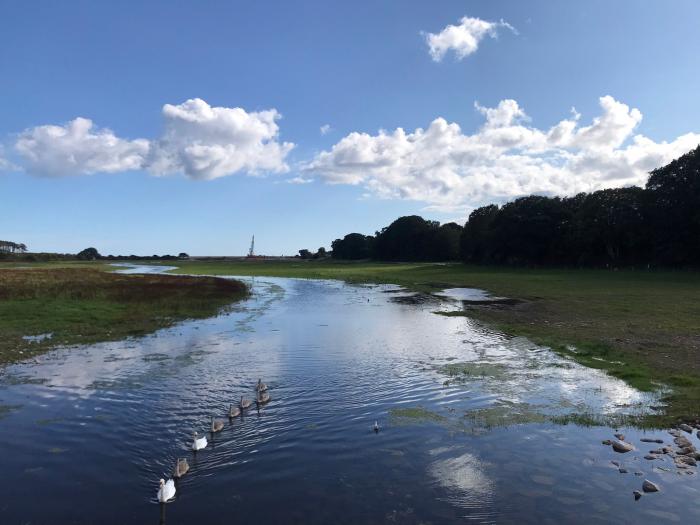
Lower Otter Estuary Walk. Kate Ponting
Cranbrook Country Park
Right on the outskirts of Exeter lies Cranbrook Country Park, a growing mosaic of meadows, tree-lined brooks, wetlands and open spaces. Covering around 30 hectares, it’s a brilliant place for families, dog walkers, and anyone looking to spend time outdoors close to home.
Cranny Brook runs through the heart of the park, offering shady spots and gentle access for paddling (or a refreshing dog dip!). Dogs with reliable recall are welcome off-lead across the whole park, and there’s even a secure dog exercise area right next to the community garden.
You’ll also find nearby facilities including a Co-op, Café 143, and the Cranberry Farm pub.
Walk at a Glance
For more information on the route: Cranbrook Country Park – devon LOVES dogs
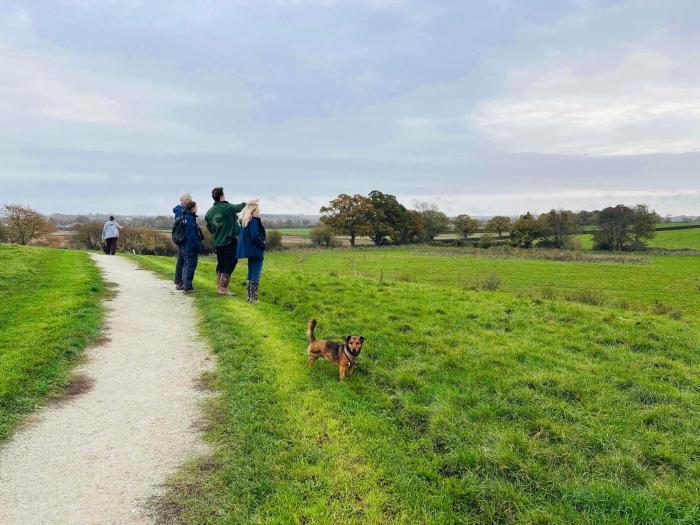
Cranbrook Country Park. Trish Waller
Ridgetop Country Park
One of the newest green spaces near Exeter, Ridgetop Country Park offers sweeping views and miles of off-lead walking on the hilltops above Matford and Alphington. Created with dog walkers and wildlife in mind, the park includes dog waste bins, clear maps, benches, and wide open areas perfect for exploring.
Teignbridge Council is actively managing the landscape for wildlife—planting spring barley for cirl buntings, creating wildflower meadows for pollinators, and leaving areas to grow naturally.
Walk at a Glance
- Length: 2.2 miles
- Dogs: Off-lead welcome
- Accessibility: 3/5 - No stiles; a mix of footpaths and quiet lanes
- Difficulty: Moderate (expect hills and big views!)
- Parking: Free (via Haldon Reach development)
For more information on the route: Ridgetop Park | South East Devon Wildlife
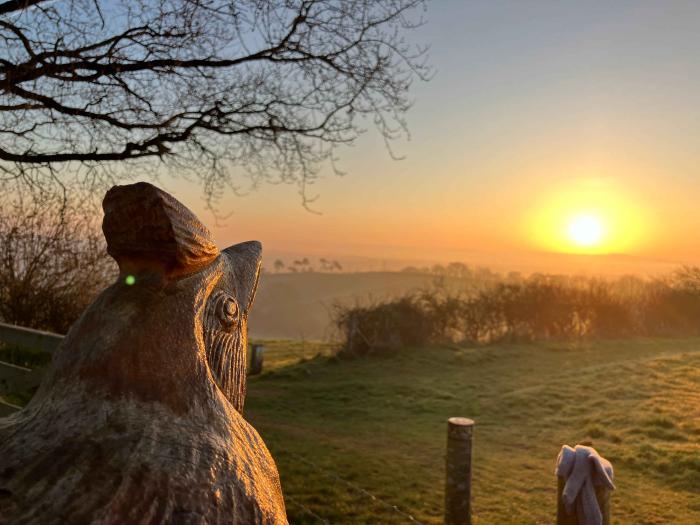
Wooden sculptures at Ridgetop Country Park
Powderham Castle & Farm Shop Walk
For a gentle winter stroll with beautiful scenery, historic charm, and close-up wildlife experiences, the Powderham Estate is hard to beat. This route offers views of deer and sheep grazing in the fields, and grey herons and little egrets roosting in the marsh.
Powderham Castle has stood on the west bank of the Exe Estuary for nearly 700 years, and the surrounding landscape has strong ties to the history of Exeter’s port, local farming, and even Brunel’s iconic Great Western Railway.
Walk at a Glance
- Length: 1.8 miles
- Dogs: On-lead
- Accessibility: 4/5- One kissing gate with wheelchair-friendly alternative available
- Difficulty: Easy
- Parking: Free (at Powderham Farm Shop/Café)
Tie your walk in with a visit to the Castle, the Farm Shop, or simply enjoy wandering through one of Devon’s oldest estates.
For more information on the route: Powderham Castle and Farm Shop | South East Devon Wildlife
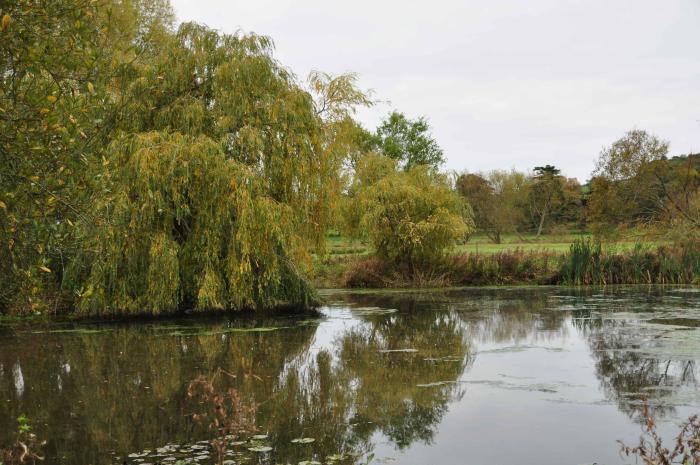
Lake at Powderham Castle.
Wrap Up Warm and Explore!
Whether you’re looking for a peaceful solo wander, a family outing, or somewhere new to take the dog on Boxing Day, these local winter walks offer space, scenery, and a wonderful opportunity to connect with nature at its most atmospheric.
For more walks visit our website: Wildlife Walks | South East Devon Wildlife
Welcome to Ryan! Dawlish Warren's newest ranger
Hi, I’m Ryan, and I’ve recently joined Dawlish Warren as a Countryside Ranger. I bring with me over ten years of conservation experience from places like Wales, Norfolk, and Malta, and I’ve been lucky enough to call Devon home for the past four years. My main focus is on practical management to help protect our dune systems, wildlife, and coastal habitats. I’m particularly interested in birds so I’m excited to see what I might find on the reserve.
On the ground, I’ll be carrying out specific habitat work, such as coppicing woodland to encourage a variety of plants and light conditions, managing grazing with our ponies to keep transitional grasslands healthy and prevent scrub establishment, and using the tractor to cut back scrub which will prevent trees and scrub from dominating the grassland. All these tasks are planned carefully according to ecological needs and the seasons.
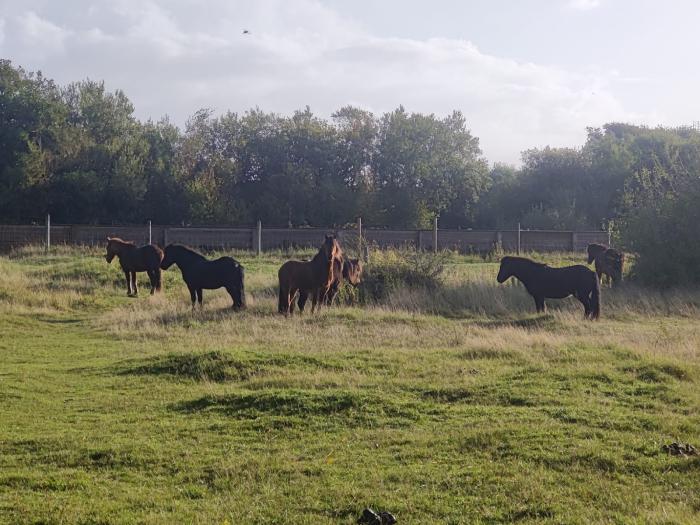
Ponies grazing at Dawlish Warren
Part of my role also involves keeping an eye on species in protected areas, making sure site rules are followed, and working closely with partners and volunteers to achieve meaningful conservation goals. I’ll be involved with engaging with the public and running education sessions with schools with the aim to help everyone understand and respect the site.
Please feel free to say hello if you see me around the reserve.
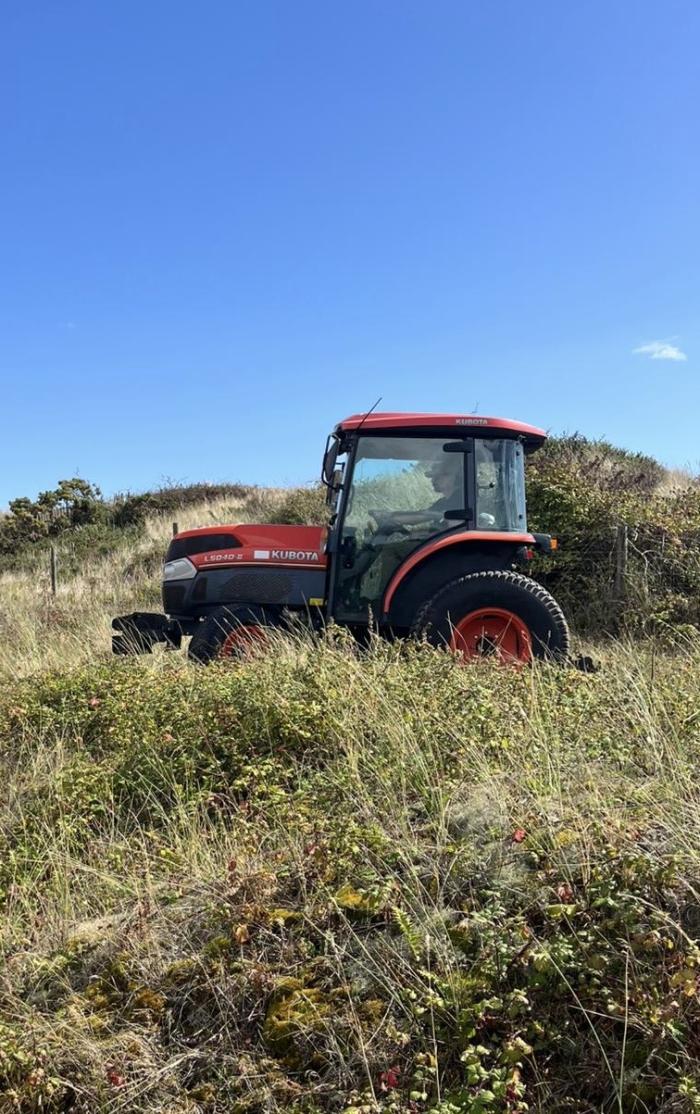
Ranger Ryan cutting scrub in the tractor
Apple Day at Aylesbeare Common RSPB Nature Reserve
It probably hasn’t escaped anyone’s notice that it’s been a bumper year for fruit, with the incredibly warm and still summer allowing plenty of pollination to occur. Out on the reserve hasn’t been an exception – with plenty of berries on the hawthorns, acorns on the oaks, and what you may not expect, apples! In fact, there are quite a few apple trees dotted about the land we manage, including 35 on a piece we’re restoring.
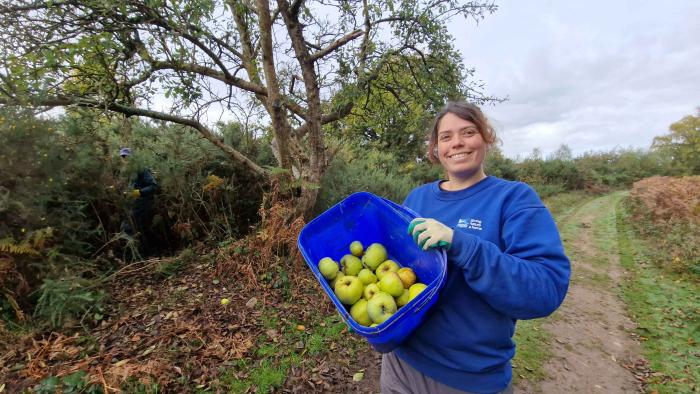
Volunteer Brigit collecting apples from the reserves
This was, until recently, a sand and gravel extraction site, but we’ve been working to restore the landscape by creating a meadow, planting broadleaf woodland and on one section, an orchard full of old Devon variety apple trees. This autumn, nearly all of the trees were fruiting amazingly well, so we saw an opportunity not to let them go to waste.
Working with the regular weekday volunteers, we harvested the shiny green and red fruits – reading the bizarre names of each variety as we went – including Pig’s Nose, Veitch’s Perfection, Bloody Ploughman and King of the Pippins. This gave us a good few bushels’ worth, but not quite enough for what we had in mind, so we expanded our search to the rest of the reserve.
We quizzed the collective hive mind of the regular volunteers, who came up with a substantial list of various other trees tucked away in corners, or growing along tracks, ripe for the plucking! After a morning’s hunt, we returned with a bountiful plunder – ensuring we left enough for the wildlife of course – and set to the next stage in the operation...pressing.
A production line was set up, with people washing, chopping, grinding and finally pressing the harvest, with some traditional folk tunes (and the odd Ian Dury song about apples) playing in the background. Containers from far and wide were filled, including plenty of old wine and gin bottles, milk jugs, protein powder pots and various cartons of all shapes and sizes, brought along to capture the sweet nectar which poured from the press.
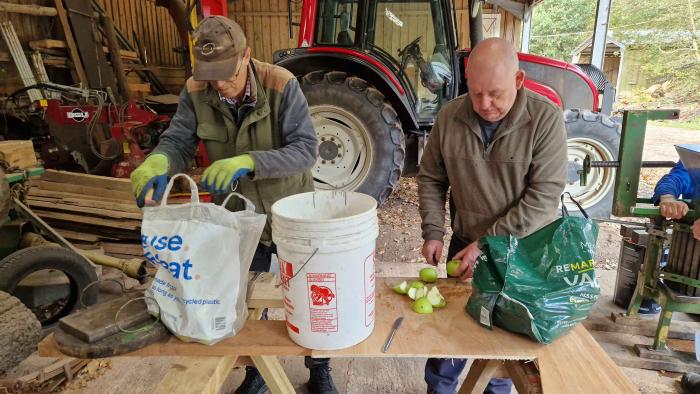
Apple production line!
It felt like a very special day, which brought people of all ages together for a traditional activity which is unfortunately something being lost across rural communities. In fact, Britain has lost over 80% of traditional orchards since the 1900’s, which has resulted in apple varieties being threatened, and a loss of the biodiversity such as insects, birds and bats that are associated with these special places. We hope that planting this new orchard will not only help in a small way to turn this tide, but is also a great way of helping to build a community.
Recommended Reading this Christmas - What the Wild Sea can be - The future of world's ocean
Earlier this year, Doctor Helen Scales visited Budleigh Salterton Literary Festival to deliver a talk on on her latest book, What the Wild Sea Can Be. Dr. Scales related that she had been prompted to assess the future of the seas after facing the same question so many times: was she hopeful about the fate of the oceans?
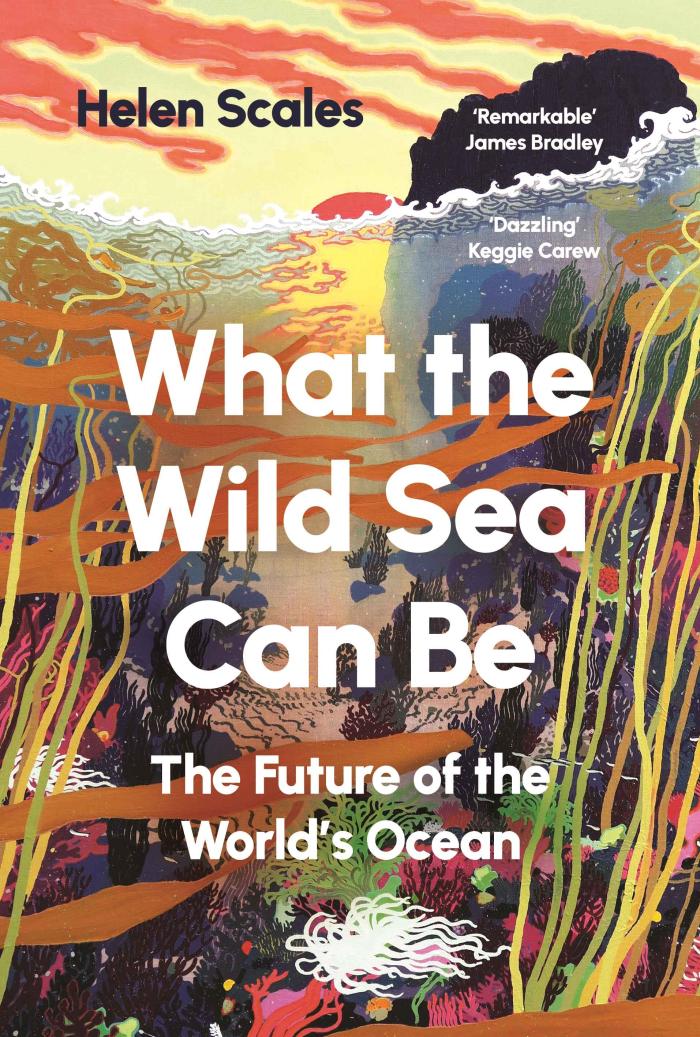
In What the Wild Sea Can Be, she combines 20 years of exploring and studying the sea, compressing all the wonders and plights, fears and hopes, past and present of our oceans into one whirlwind trip to try and answer that very question. Scales was shortlisted for the 2025 Women’s Prize for Non-fiction and the Wainwright Prize and is my recommended reading this Christmas.
Scales plunges her readers into the 21st century, identifying the three main things humans do that change the ocean: overfishing, pollution, and climate change. For example, climate change is forcing species to move, adapt or perish. The heating currently happening in the sea will create what Dr Scales calls “winner” and “loser” species.
Scales pinpoints a potential “winner” species, already triumphing in the seas: the lionfish. Due to new connections between seas, like the expanded Suez Canal, and the release of the foreign species in new waters, as well as changing sea temperatures, lionfish have moved from the Indian and Pacific Oceans to Atlantic waters. In the Caribbean, lionfish were finding it so easy to hunt, some were recorded to be experiencing Fatty Liver Disease, something only usually found in pet fish when they are fed too often.
Our rivers, while bereft of lionfish, have other wonderful winner species, such as Little Egrets. Once a rare spot, this bird has become a common resident in the waters of the Exe, with its migrant status being removed as groups now breed locally. This has been enabled by warmer winters, reducing mortality rates and allowing year-round feeding. Warmer climates are not the only thing our egrets have benefitted from – wetland restoration, particularly on the Lower Otter Estuary carried out by our partners the Pebblebed Heaths Conservation Trust, have given them safer, richer habitats. Even Greater Egrets, so rarely seen on our shores before, are following the European trend with sightings increasing.
Dr Scales’ book compiles success stories and natural tragedies in equal measure, gradually building not just an assessment of our marine wildlife’s future, but a reminder of why it should be protected. With the festive season approaching, we think What the Wild Sea Can Be is the perfect read to remind us of how precious our seas and the creatures living in them are; it’s a perfect gift for anyone passionate about wildlife, or a thoughtful addition to your own reading list.
Want to contribute to local wildlife conservation?
We're currently seeking volunteers who can help with any of the following:
- Events - engaging the public in conversations about wildlife and assisting with the smooth running of events and pop-ups.
- Foot patrols - walking with our wardens across our three key sites.
- Boat patrols - accompanying our wardens on the Exe Estuary, driving the patrol boat (Powerboat Level 2 required).
If you are interested in helping our team in any of these roles please get in touch at: [email protected] to find out more